Home
Links
Contact
About us
Impressum
Site Map
YouTube Links
Spotify Links
App Download
عربي
Aymara
Azərbaycanca
Bahasa Indones.
বাংলা
Български
Cebuano
Deutsch
Ελληνικά
English
Español-AM
Español-ES
فارسی
Français
Fulfulde
Gjuha shqipe
Guarani
հայերեն
한국어
עברית
हिन्दी
Italiano
Қазақша
Кыргызча
Македонски
Malagasy
മലയാളം
日本語
O‘zbek
Plattdüütsch
Português
پن٘جابی
Quechua
Română
Русский
Schwyzerdütsch
Srpski/Српски
سِنڌِي
Slovenščina
Svenska
தமிழ்
Türkçe
Українська
اردو
中文
Home -- English -- Guide to Jesus FORM: -- act in a PLAY -- listen to AUDIO -- read a STORY? -- Guide to Jesus
WINNING CHILDREN FOR JESUS CHRIST
How you can lead a child to Jesus Christ
To Chapter: 01 -- 02 -- 03 -- 04 -- 05 -- 06 -- 07 -- 08 -- 09 -- 10 -- 11 -- 12
Index
01 Welcome
Winning children for Jesus Christ. This is the title of these pages, and this is our desire. For this our hearts beat. This is our goal.
Winning children for Jesus Christ. Hardly any other topic demands more wisdom and sensitivity. It is clear that faith is a gift from God, thus any kind of manipulation is out of place. In addition, it is a fact that God speaks to children, and they then long for forgiveness of their sins and a changed life. The following pages keep this balance and are a great help to all those who want to accompany children as they take their first steps toward Jesus Christ.
Winning children for Jesus Christ. Only someone who longs for children to come to know Jesus Christ and who has much experience in this can write about it. Both apply to Elfriede Grotz. These pages reflect this and thus make them both beneficial and practical for all who have the same desire.
CEF Germany
Children discover the Bible
02 Winning Children for Jesus Christ
Our theme: How you can lead a child to Jesus Christ
One could hear a needle falling. The boys and girls at the children’s meeting listen to the exciting mission story about Jesse Overholtzer with open eyes and ears. They are fully engaged as he and his friends entice a cow onto the barn roof at midnight, and he, as a 12 year old boy, secretly runs away from home. The children see first-hand how Jesus Christ pursues him and shows him His love.
Jesse Overholtzer became a preacher. Spurgeon’s books captivated him. There he came across the claim that when a five year old child is carefully taught, he can believe and be born again just as an adult can.
"That isn’t true!", shouted Overholtzer out loud. "Children can’t believe and be saved. They are too young." He slammed the book closed and put it away. Shocked, the children cry out, "But it is true!"
And they are right. Some of them know from their own experience that Jesus Christ saves children.
Would you have protested if you had been at this children’s meeting?
At the end of the story, the children breathe a sigh of relief because Jesse Overholtzer changed his opinion. And even more: an "experiment" with children convinced him so much about the truth of Spurgeon’s statement that he dedicated his whole life to child evangelism. In 1937 he founded the organization Child Evangelism Fellowship (CEF).
CEF is an international mission organization. The co-workers are active in almost every country in the world, winning children for Jesus Christ.
Would you also like to participate and win children for the Lord Jesus in personal conversations, in Sunday school, in retreats...?
The following pages answer the question: How can you lead a child to Jesus Christ? The answers come from experience that is put into practice, and are good instructions for your ministry with children. The experience, many children and many examples show God’s deeds with young people and honor him.
- "Winning children for Jesus Christ" is an encouragement for those who want to lead boys and girls to faith in the Lord Jesus. Don’t give up on this goal! Not even when you experience push-back. A woman said, "In the church I’m scolded because I lead children to Jesus."
- "Winning children for Jesus Christ" is a guide for all who have questions about child evangelism.
God’s will is the main reason for these writings.
"So it is not the will of your Father who is in heaven for one of these little ones to perish" (Matthew 18:14).
Be blessed,
Elfriede Grotz
03 The Spiritual Ministry of the Children’s Worker
Leading children to Jesus Christ is a high point in the evangelistic work with children. As Oswald Chambers wrote, "One never gets used to this indescribable miracle when a soul meets God."
Experiencing first-hand the conversion of someone: this is both a privilege and responsibility at the same time. Education is not an absolute necessity in order to help in this.
Here the emphasis is placed on three simple yet highly effective prerequisites.
Requirements for the Worker
1. Their personal life of faith
The rebirth, faithful growth in faith, as well as obedience out of love for God are the most important requirements for the worker. This person is a passionate Bible reader. Through this he grows in faith and in the knowledge of the Lord (2 Peter 3:18). His life bears fruit.
2. Their conviction
Whoever wants to lead children to Jesus needs a two-fold conviction. Firstly, believe that children need salvation, and secondly, believe that God wants to save children.
3. Their example
The worker’s life must coincide with his message. Only the one who is led by God’s Word in thoughts, speech and deeds is believable and can give others orientation. We are only as much a Christian in public as we are in private.
Being an example must not be confused with or compared to perfection.
Whoever seems "perfect" in public and apparently knows everything and can do everything, often appears to be legalistic and without understanding.
Not perfection but rather an exemplary life will convey a credible example of discipleship to children.
Food for thought:
- When have you asked a child for forgiveness?
- Do children see how you master problems with Jesus’ help?
- Do children see that you have a life of joy and fulfillment in Jesus?
An example convinces. Hence we look now at the unique example of the Lord Jesus Christ.
"Then they [the Pharisees] were saying to Him, ‘Who are You?’ Jesus said to them, ‘What have I even been saying to you from the beginning?’" (John 8:25)
And because Jesus Christ is our example, we ask Him to make us like Himself. Then children will say, "I first loved the person who told me about Jesus, and then I loved Jesus."
Three Characteristics of a good Spiritual Companion
1. He has time
Approximately 20 minutes are enough to lead a child to Jesus Christ.
Having time means that the spiritual companion is 100% present with the child. Also present with his thoughts. He avoids putting the conversation under time pressure. Sometimes it can be better to schedule an appointment to talk the next day.
2. He listens closely
It is a huge relief for many children when they can tell their spiritual companion everything that concerns them. This is why listening is so important. Neither good advice nor the fitting Bible verse need to be said immediately. These can follow with time.
Listening closely also means discerning what remains unsaid. Children express themselves in different ways. Some have difficulty saying what truly moves them. Some will hold back because they’re ashamed.
The Lord will answer a silent prayer for wisdom and understanding.
3. He can be quiet
It should be clear that the spiritual companion is not allowed to tell others what the child said in confidence. Boys and girls would be deeply hurt if their trust was abused.
Sometimes God pulls the curtain aside and lets us see His work in boys and girls. He gives us the beautiful task of helping children take a step toward Jesus. He blesses this ministry that we do according to His will and in dependence upon Him.
04 Can Children be Converted?
What speaks for child conversion?
1. God’s Word
The Bible often speaks about child conversion. On this topic the Creator has clearly communicated His will.
Deuteronomy 31:12-13 "Assemble the people, the men, women, the children (...) so that they may hear (God’s Word) and learn and fear the Lord your God (...) And their children, who have not known, will hear and learn to fear the Lord your God, as long as you live on the land..."
Matthew 18:14 "So it is not the will of your Father who is in heaven for one of these little ones to perish."
John 1:12 "But as many as received Him, to them He gave the right to become children of God, to those who believe in His name."
Many Bible verses talk about children, others include them. For example:
Psalm 78:3-7; Matthew 19:13-15; John 3:16; Acts 2:21.
These and other Bible passages show that children are not only to be instructed in God’s Word, but that it can also evoke a response in their heart.
2. The experience
An unmistakable proof that children can be converted is experience. Countless boys and girls have accepted Jesus as their Savior and Lord. For many, faith has proven to be a solid foundation and influence even into adulthood.
Surveys conducted at theological seminaries have shown that sometimes more than half of the students came to faith as children.
After a week of evangelistic meetings for children, a co-worker said, "It was an important experience for me to see that children accept Jesus deliberately. To me it was clear how incorrect my thinking has been. I shared the gospel with the children and at the same time made it difficult for them to entrust their lives to Jesus. I didn’t give them a chance to do so because I thought that children are not mature enough or were saved anyway.
As I experienced how children can be saved, my eyes were opened. Children need salvation. I’m so thankful to the Lord for this correction. It was absolutely necessary for me."
A missionary to children reported from the tent campaign, "After the children’s program, a 12-year-old boy said, ‘I was here every evening but I didn’t have the courage to go forward. Thank you for also inviting children to come to Jesus. That’s when I finally found the courage.’"
3. Personal testimonies
Historical examples:
Count Zinzendorf (1700-1760), a father of Pietism and the missionary movement, became a believer at 4 years old.
Corrie ten Boom (1892-1983), who saved many Jews in Holland during the Holocaust, accepted Jesus into her life when she was 5 years old.
Contemporary examples:
A CEF Mission leader came to faith during an evangelistic campaign when he was 12 years old.
A renowned professor testified: "I was privileged to be converted at the age of six. It wasn’t a feeling but a clear conviction of sin after a Bible study. I experienced these reactions as a child: my parents taking my faith seriously and both the open and secret rejection of my testimony by others. I know from this how important it is for children to have their faith taken seriously, to be encouraged in it, even when they are not so competent yet in other areas."
A previous German TV moderator became a believer at 9 years old.
Susanne is a nurse, married, with two adult children. She and her husband are engaged in mission work and lead children to Jesus. "I well remember the children’s meeting where you told us about a girl whom you helped come to faith. I was so impressed and amazed by Jesus’ love that I went home, wrote down all my sins on a piece of paper, brought them to God in prayer, and asked for forgiveness. Then I solemnly destroyed the paper." Susanne was 11 years old when she did this.
4. Quotes from famous Christians
Within the Christian community, the opinions about child conversion vary widely. But this topic has many proponents whose statements have had, and will continue to have, positive effects.
Charles H. Spurgeon (1834-1892) was an English revival preacher in the second half of the 19th century. His sermons and writings are still read worldwide today. He said that a 5-year-old child, when correctly taught, can believe and be born again just as an adult can. He was convinced that those who were converted as children count among the best believers, and in the long run are the most steadfast and reliable.
D. L. Moody (1837-1899), one of the most famous North American evangelists, recognized that much unbelief in churches stands in the way of children’s conversions, and only a few people believe that children can be born again. He expressed the hope that this would change.
The lecturer at a large Bible school said, "... Now we would like to point out the importance of working with children. Children have the strong intuition, the inner knowledge about God, that is powerfully active. For this reason, as believing parents, it must be our endeavor to instill this knowledge in our children when they are young. However, they are also to be led into a personal relationship with God through repentance and conversion, preferably before they start school."
A youth evangelist noted, "Although children are not my target audience, in recent years I observed a noticeable increase in child conversions. Sometimes there were even more child conversions than with adolescents."
The source of our mandate to win children for Jesus Christ is God’s Word. The experience, the personal testimonies, and the quotes from many advocates are the river that springs up to water your ministry to children and sweep it along in this purposeful work.
All of this culminates in the well-known words of the Lord Jesus:
"Allow the children to come to Me; do not forbid them…" (from Mark 10:14-16).
05 Reservations and Prejudices on the Topic of Child Conversion
Child conversion is not always seen positively. It also encounters reservations and prejudice. One factor could be the world view on which a person is judged. According to the humanistic view, man is good. But according to the biblical view, man is by nature a sinner.
A pastor shared his opinion with me in a letter. "Do our children, who grew up in Christian homes, need conversion? The question is, from what do they convert? Is it necessary to make a conscious decision for Jesus, or is it many small decisions based on their age, that need to be made again and again? Jesus said that his heavenly kingdom belongs to the children." His arguments were directed against evangelistic preaching, for it "produces severe feelings of guilt for children, feelings they cannot cope with." Furthermore, he criticized the "theologically extremely questionable portrayal of the ‘narrow and broad paths’, with their inevitable destinations of heaven or hell—and nothing in between."
In my Bible, I find no passage in which God speaks of an "in-between". And regarding "severe feelings of guilt," I can say from experience that anyone who speaks of sin to children tells them nothing new. Many are aware of their guilt. I have often found that children are waiting for someone to tell them how and to whom they can unburden themselves.
I have often given children this tip: "Write down on a piece of paper all the sins you are aware of, the ones that weigh on your mind. Take that to the Lord Jesus. Confess everything to Him in prayer and ask Him for forgiveness."
In my mind’s eye, I see Achim before me. He spontaneously sprang from his chair and exclaimed: "That’s going to be a long list!"
Confessing guilt. Making a fresh start. Many boys and girls long for this. You can tell them the good news that the Lord Jesus forgives all sins.
Reservations and prejudices build a wall that makes it (almost) impossible for children to go to Jesus, the Savior.
But walls can fall, and bricks can be carried away. Do you want to take part in this?
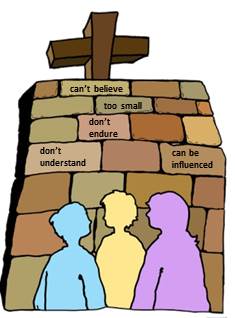
1. "Children don’t yet understand everything"
This is correct. Yet they will believe in accordance with the Word
of God and their understanding. And God takes this seriously.
By the way, do adults understand everything?
In spiritual matters, the intellect is not the decisive factor.
For if that were the case, far more people would follow Jesus.
It is not the intellect that saves, but faith (see Ephesians 2:8). It is God’s Spirit who leads to the knowledge of the truth, calls to faith, and enables us to grow therein.
2. "Children are too young"
In John 3:16 it says: "For God so loved the world, that He gave His only Son, so that all who are over 12 years old and believe in Him will not perish, but have eternal life."
Forgive me... this Bible translation does not exist! Not a single Bible verse states that conversion is only possible after a certain age. Instead, God says in His Word that He reveals Himself in love to the lowly, the weak, and the young.
When is a child old enough to accept Jesus Christ?
The answer is fourfold:
- When the child has recognized that he is loved by God.
- When the child possesses a consciousness of good and evil.
- When the child has learned that Jesus died for his sins.
- When the child voluntarily desires to confess and forsake sin.
On this basis, a child is ready to accept Jesus as Savior and Lord.
For one child, this may happen sooner, for another, later. This is because God has a deeply personal history with every individual.
I am not one of those who blame everything on the devil. But I know that the enemy of God knows the value of a child’s soul.
"There is still time for that…" This is an opinion he likes to foist upon Christians, especially when it comes to the conversion of children. Does conversion really have time? If so, how much?
My thoughts turn to the cancer ward at the children’s hospital. I think of the newspaper article, "Ten-year-old killed by school bus."
I stood at Lena’s grave, who lost her life in a car accident. When she was eleven, she asked me, "Can you really have eternal life? If so, how?"
Nothing is as urgent as the conversion of a person. Nevertheless, we must not exert pressure. We share the good news of Jesus with the children and trust that God’s Word will not return empty (see Isaiah 55:11).
If a person comes to faith in Jesus while still a child, then an entire life is saved!
It is a great blessing when the course for both time and eternity is set right as early as possible, and God becomes the Lord of one’s life!
It is a great honor for the Creator and Redeemer when someone becomes His own while still a child, and God is able to make history with that life!
How old were you when you came to faith? I suspect that many readers of these pages came to know the Lord Jesus as children.
3. "Children don’t persevere"
The question of perseverance is justified.
Do children persevere? No.
Do adolescents persevere? No.
Do adults persevere? No.
Does God hold His children fast, and can He complete His work in them? YES!
That is a fact. And that is why I, too, am still on the journey with Him.
The gracious, merciful, and patient God is a mighty Redeemer! He has purchased people with His blood. How could He ever let even one of them go? Never!
Jesus, the author and perfecter of our faith (see Hebrews 12:2), has promised: "… no one will snatch them out of My hand (...) no one is able to snatch them out of the Father’s hand" (John 10:28–29).
Children of God are, so to speak, held by both hands.
It is true that even children are not spared from difficult times. It is also true that some struggle. The parable of the four soils applies to children as well. But this cannot be used as an argument against the conversion of children, for it does not serve as an argument against the conversion of adults who later go their own way.
Our ministry among children involves disappointments. There are some children whom I have not seen since their conversion. That hurts. But God watches over them. In His own time, He reconnects with His children.
A spiritual birth can no more be undone than a natural birth.
Part of a worker’s responsibility is to carry out effective follow-up work. And above all, this includes faithful prayer for the child.
Reservations and prejudices regarding the conversion of children often stem from one’s own life history.
Anyone who experienced his conversion under pressure or fear will sense pressure at the slightest call for a decision. And because he wishes to spare children from this, he may fall into the opposite extreme: he never invites the children to come to Jesus.
My advice: As an adult, put a definitive end to your past and approach the subject anew and objectively.
Or, to use an analogy: If someone fell off a horse as a child, he must not forbid children from climbing onto a horse. Instead, he should hold the stirrup and help them mount.
We will dismantle further bricks in the wall of reservations and prejudices later.
But the best answer to all prejudices is given by children themselves.
"I can still remember exactly how you invited children to come to Jesus. We were already on our way home when my friend said, ‘We’re going there.’ So we turned back, and not just to the schoolhouse (note: That is where the children’s event took place), but also to God. I have never regretted my turning to him. Although I was often unfaithful, the Lord Jesus accepted me again and again. I have found many verses in the Bible that encouraged me during difficult times, for example, Psalm 121 or Joshua 1:9." — Tina
"After the Children’s Bible Week, I was really happy that I am a child of God. My mother was also nicer than usual for a few days." — Mariette
"Sometimes others laugh at me because I am a Christian now. But I do not regret having welcomed Jesus into my life." — Renate
"I find it very beautiful to live for Jesus. I can rely on him. And because I follow Jesus, I have the certainty that life goes on, and that Jesus directs and guides my life." — Marie
"I am still walking my path with Jesus, and I believe I will never lose my way again. I can tell him everything, and he helps me. I have felt absolutely wonderful ever since the children's retreat." — Katja
06 The Spiritual Guidance of a Child
We want to help children in their faith and life questions with loving, spiritual guidance. This sometimes extends over years and is not merely a one-time conversation with the child.
We distinguish between three types of spiritual guidance.
1. The spiritual guidance to accepting salvation
The guidance occurs through biblical stories, songs and other program points. Role models and children’s experiences also play an important part. A sense of guilt, questions about life and life’s meaning waken the longing for God. Even facing illness and death can lead to God. And last but not least, family situations can also pave the way – including those marked by distress, be it alcohol or drug addiction in the family, abuse, divorce, violence, overindulgence, or neglect.
A brief digression is in order here:
"Broken homes!" This seems to be a widely used phrase. I’m often shocked by the way children in distressed family situations are written off. Is there really no more hope? Are there perhaps cases that are too difficult for God? Where is the faith that the Creator wants to save His creatures?
An acquaintance told me a story from her neighborhood. "The marriage fell apart. The wife moved away. I feel so sorry for the children." She said her conclusion in the next sentence. "What is going to become of the children?"
Deeply moved, I hung up the phone, but at the same time hope dawned in my heart. Could the hardships in the home not be exactly the place where God wants to reveal Himself?
I know someone from a broken home. In her town, God set up an evangelistic campaign for her. She was the only one who came to faith. Later she heard God’s call to be a missionary. God used her life to reach innumerable children in Germany and worldwide with the gospel, personally, in writing, and through the audio dramas "Stories for Children" in more than 40 languages that you can find on the platform www.wol-children.net.
A glance at church and missions history shows us that God empathizes in a special way with those who entered life bearing a heavy legacy. To Him it is unimportant if someone comes from a broken or an intact family. To God, only love for Him and devotion to Him count.
It has often thrilled me when precisely those children responded to God’s call from whom one would have least expected it.
If we’re honest, we have to admit that every person has scars and deficits. No one is exempt, not even those with seemingly intact families.
Perhaps you carry a burden about which no one knows. Don’t give up! Be courageous, hold fast to hope, for...
"The Lord is near to the brokenhearted and saves those who are crushed in spirit" (Psalm 34:18).
Because I believe that, I have a special love for children who are struggling.
I want to inspire you with this. For both the beautiful and the difficult can be a guiding grace. God’s ways are always good. With everyone. The Lord can make a song out of suffering. The suffering that God transforms blends harmoniously into the melody of life.
2. Spiritual guidance in the acceptance of salvation
This is about having a personal conversation with the child who seeks the help of the worker, in order to ask Jesus into his life as Savior and Lord.
Later I will go into this in detail.
3. Spiritual guidance following the acceptance of salvation
This refers to accompanying a born again child. Through prayer, conversations, and the practical training of the spiritual life, the child is to receive help so that he or she may follow the Lord Jesus faithfully and with joy. Follow-up care is of great importance.
Following this overview we present a path the child can take to personally receive salvation.
God’s mandate is our responsibility: to share the gospel with children.
Many children’s workers do this with dedication and great commitment. Their love for the children is visible. Yet only few of them give the boys and girls the opportunity to respond to what they’ve heard.
A co-worker said in astonishment, "Give children the opportunity to accept Jesus? We’ve never done that."
In Paraguay after a seminar, a woman made a confession on this topic. "For 20 years I’ve led Sunday school, but I’ve NEVER called children to make a decision. This has to change."
Some boys and girls would have come earlier to Jesus if they would have had the possibility to do so. Evangelistic campaigns for adults confirm this. Surprisingly many children come to faith there. Why? Because there’s an invitation to come to Jesus.
Immediately after her conversion, Anna said to her friend, "If only we had done this much earlier!"
Experience teaches that children need spiritual guidance. Many need a concrete, inviting offer. For only a few children seek out a personal conversation on their own, perhaps because they are shy. Therefore a link is needed between the preparatory guidance and the personal conversation with the child.
The following pages show how children can be offered the opportunity for a personal conversation.
07 Offer Children a Personal Conversation
What is the offer of a personal conversation NOT?
- It is not pressure.
- It is not emotional manipulation.
- It is not intimidation or threats.
- It is not persuasion or enticement with gifts.
What IS the offer of a personal conversation?
- It serves as the link between the proclamation of the Gospel within the group and the personal guidance of a child.
- It is like a bridge that the child can cross to receive what they have heard about.
- The offer of a personal conversation gives the child the opportunity to respond to God’s call.
Why do we offer children the opportunity for a personal conversation?
1. Because we trust that God, through His Word and His Holy Spirit, is at work in the hearts of children, hearts that may then wish to respond to the Gospel.
2. Because we would love to assist children who wish to accept the invitation of the Lord Jesus, yet we do not know who is in need of such help.
3. Because we want to reach out to those children who would not take the first step on their own initiative.
How should the offer of a personal conversation be extended?
The manner in which this offer is made will be colored by one’s own personal history. I personally like to offer children the opportunity for a private conversation, as it proved to be of great help to me during my own conversion.
I do not call upon children to come forward, nor do I ask them to raise their hands or to stand up. I wish to avoid any form of group pressure.
The offer of a personal conversation, like any service rendered to the Lord, must be made with a sense of accountability before God. In doing so, the dignity of the child must be respected.
Most of the time, I invited children to speak with me after the children’s meeting. During an evangelistic children’s week, I preferred to invite them for a specific time the following day. I have had very positive experiences with this approach. When a child had time to reflect and subsequently kept the appointment, I viewed this as a first sign that their interest was genuine.
In the children’s program, there are various ways to offer children the opportunity for a personal conversation. This does not and indeed should not always take place at the end of the biblical story.
08 Program Elements for a Personal Conversation
1. The song
Many children’s songs contain the gospel message and are well-suited for offering children a personal conversation in which they can accept the Lord Jesus’ invitation.
For example, the song: "No one is too big, no one is too small..." The chorus says, "God opens the door to everyone, to everyone who asks Him. He takes away the guilt and gives love in return, for He has told us so."
(For workers in children’s ministries: You can replace this song with a song in your own language and link the offer for a personal conversation to it.)
Then you could pick up on this and say, "God loves you. He opens the door for you, too. Is guilt weighing you down? Jesus wants to forgive you so that you may find joy again.
Tell Him everything in prayer. You can do that alone at home. Or, if you have any questions about it, you can come to me after the children’s meeting. I’ll have time for you then. Do come and tell me if you’d like."
2. The biblical story
Many stories in God’s Word invite people to come to Jesus in prayer.
Whether it’s Zachaeus, the one who literally took Jesus in, or Peter, who, after the great catch of fish, fell at Jesus’ feet in a realization of his own sinfulness. With the story of the healing of the paralyzed man, you can quite naturally emphasize that Jesus forgives sins, then and now. And the repentance of the Prodigal Son can serve as a model for your children’s group.
Example: "Would you like to follow the example of the Prodigal Son and admit that there is sin in your life? You don’t have to wait until you are grown up. Right now, the Lord Jesus wants to forgive you and accept you. Come to Him. He is waiting for you because He loves you. After the children’s meeting we can talk about this. You can confess your sin to Him in prayer and ask for forgiveness. However, if you go straight home, you can also do this alone in your room. Jesus is everywhere."
It is important to offer children both options. They can seek assistance, or they can do it on their own. Then, aim to have a follow-up conversation by saying: "If you have accepted the Lord Jesus on your own, I would be delighted if you told me about it. And I can offer you some tips for your life with Jesus."
3. The Bible verse
Many Bible verses also lend themselves to inviting children to a personal conversation.
Example: In John 6:37b, the Lord Jesus promised: "… the one who comes to Me I certainly will not cast out."
"This applies to everyone. To all children. To even you. Anyone is welcome to come to Jesus. He turns no one away even though He knows everything about everyone. He wants boys and girls to come to Him. Will you come to Him? You don’t have to become good or do good deeds first. Come just as you are. Jesus is waiting for you. Ask Him to forgive your sins and accept you. He answers such prayers immediately. If you like, we can pray together afterwards."
Missionary stories, examples of people who have accepted Jesus, as well as your own conversion experience, offer further opportunities.
The invitation to come to Jesus and the offer of a personal conversation should be woven into the program quite naturally and not always at the same point, otherwise the children will tune out.
How a personal conversation should be offered
1. Briefly. A few sentences suffice.
2. Personally. Use the informal "you." This feels more personal than "we," "you" (plural), or "one."
3. Clearly. Afterward, every child should know exactly how, when, and where they can take advantage of the offer to talk.
4. As something voluntary. "If you would like to..." The conversation should be offered in such a way that children can choose to accept it immediately or at a later time. Each child is free to decide for themselves whether to take the step toward Jesus alone or to make use of the personal conversation.
How often should a personal conversation be offered?
In her book "Arbeit unter Kindern" (Working with Children, now out of print), Ruth Frey writes, "It is necessary to extend the invitation again and again, and always with kindness. Whether or not it is accepted lies with the child. Since no one knows when God has prepared a child, the invitation cannot be extended often enough. Perhaps the child will not return. The responsibility is great."
If the event is a regular, weekly meeting for children, it is not necessary to offer a personal conversation every single time. Offer it only when the story suggests it or when the topic is evangelistic in nature. This way, you avoid the risk of the children tuning out at the crucial moment. If the offer of a personal conversation is made too frequently, there is a risk that it will no longer be heard or taken seriously.
I would like to encourage you to reach out to children and offer them a conversation.
Remain connected to the Lord Jesus so that He may accomplish through you what He has purposed. He will grant you the right words.
Expect and trust that God is at work in the hearts of children through His Word and through His Holy Spirit, and that, through you, children will be won for Christ.
After a seminar on this topic, Maike said, "It’s true. We often trust the Lord much too little. On Monday I offered a personal conversation to the children.
And sure enough, a boy came and gave his life to Christ. He is eight years old and has been coming regularly to the children’s group for four years."
You can be the person for a specific child who helps them open the door
so that they may gain access to the Kingdom of God and be saved for time and eternity.

09 Spiritual Guidance in the Acceptance of Salvation
The setting
Prepare a "talk to me" seating area, a place where the conversation can take place without interruption. Perhaps a separate room is available to you. A bright, nicely arranged room creates a pleasant atmosphere. Do not close the door; instead, leave it open. Any appearance of impropriety must be avoided. For this reason, a male staff member should conduct conversations with boys, rather than with girls. Another adult should be nearby. Have your Bible and writing materials ready. Also, have materials ready for follow-up care after the child accepts salvation, for example, a Bible and a Bible reading plan. Your friendly and natural demeanor will help the child overcome his nervousness.
Make the diagnosis
Not like this: "It is wonderful that you want to confess your sin to Jesus. Fold your hands, close your eyes; let us pray now." Any child would be overwhelmed by such an introduction.
Under the guidance of the Holy Spirit, you should first find out where the child stands.
The following questions can be helpful:
"Why do you want to talk to me?"
"Do you have any questions?"
"Why did you stay behind?"
One girl replied, "I wanted to ask why the Children's Bible Week goes by so quickly."
This introductory conversation is important, as it allows you to determine whether the child has understood what is at stake and what kind of help they need.
Find out which of these four diagnoses applies to the child.
1. The child did not understand what it was all about
They may have simply heard that one can go to the "talk to me" corner, and that is why the child is there.
2. The child is not serious
It is possible that the child simply followed others or came to the designated place out of curiosity. A sense of conviction regarding sin is lacking.
I have sometimes asked directly, "Did you come because your friend was there?"
Children belonging to these first two groups are not yet mature enough to take the step toward Jesus. Nevertheless, treat them with kindness and do not show any disappointment. You can encourage them to reflect once more on what they have heard. Tell them that they are welcome to come to you with questions at any time.
3. The child is already saved
There are several reasons why a child might want to repeatedly invite Jesus into their life.
3.1 Lack of assurance of salvation
When I asked, "Why do you want to receive Jesus again?" I once received the answer, "Just to be sure."
Citing John 1:12, you can assure the saved child that he or she is a child of God. Giving thanks is also an important step in helping the child gain assurance of salvation. Using a passage from Ephesians 1, encourage the child to give thanks for salvation, forgiveness, and eternal life, for everything they have received in Jesus. Also, encourage the child to confess the Lord Jesus.
3.2 The child has sinned again
It will be helpful to the child if you speak about the reality of sinning again in the life of a child of God. The child should know that, despite their failure, they remain a child of God, albeit a disobedient one, and are not lost. The child may confess his guilt to Jesus and ask for forgiveness. Encourage the child in this by citing 1 John 1:9, "If we confess our sins, he is faithful and just to forgive us our sins and to cleanse us from all unrighteousness." The child does not need to receive Jesus into his life once again, but can make a renewed commitment to Him.
3.3 The conversion was so beautiful
Because the joy, the attention, and the emotions surrounding the conversion were so beautiful, the child may wish to experience this again.
If this is the case, then rejoice with the child over that past experience. Invite the child to join you in a prayer of thanksgiving. Speak with the child about the constant presence of the Lord Jesus (Matthew 28:20). He is there, even if one’s feelings suggest otherwise. He stands by our side when we are going through difficulties. He never abandons His children. Send the child on their way with God’s promise from Hebrews 13:5, "I will never leave you!"
4. The child has understood what this is about. He or she is not yet saved and wishes to receive Jesus into his or her life.
If the child belongs to this group, then you can help them come to Jesus.
Leading a child to Jesus Christ
With the question, "Why would you like to invite Jesus into your life?" you give the child the opportunity to express what is going on in his heart.
1. Use the Bible
The child is determined to confess his sin and receive Jesus. In the subsequent conversation, base your discussion on a specific Bible verse, for example, John 3:16, John 6:37, Romans 10:13, or 1 John 1:9. Alternatively, you may refer back to the biblical story, song, or other material presented during the children's meeting.
Use only one Bible verse or point of reference from the children’s program to ensure the child does not become confused or overwhelmed.
The central focus of a conversation regarding the acceptance of salvation is Jesus Christ. He desires to become the Savior and Lord of a person’s life.
Some children are filled with wonder at spiritual truths. Damaris remarked, "I have never heard before that Jesus forgives all sins."
The child is to grasp four truths of the faith
The little "Wordless Book" illustrates these simply and vividly using four colors.
Gold Page: The nature of God. His love and holiness.
Dark Page: The reality of sin in the life of every human being. Its effects and punishment.
Red Page: Jesus Christ, the Savior. He died for all sins and sacrificed His blood and His life. Jesus has risen. He is the only way to God.
White Page: Acceptance of salvation. Through forgiveness, the Lord Jesus cleanses us (snow-white) of all guilt. This is eternal life.
Is the child aware that he needs saving? If so, he should learn how he can be saved.
Example: What does someone do when they are drowning? They cry out loudly for help.
In this regard, Romans 10:13 instructs, "For everyone who calls on the name of the Lord will be saved." Calling upon Jesus saves us from sin and lostness.
2. Do you really want to?
Accepting Jesus as Savior is vital. Yet, before the child takes this step, he should also be reminded that the path with Jesus is not always easy.
Following Jesus is no guarantee of top grades in school, nor of wealth, good health, or prosperity. It is not sunshine every day. Discipleship has another side as well, and that must not be left unmentioned.
Therefore, say to the child, "It is possible that your friends won’t understand you. They might even laugh at you and mock you. Do you still want to live with Jesus?"
Such can be the consequences of following Jesus. Encourage the child to walk with Jesus nonetheless. Life is full of difficult times. Yet for those who know Jesus, He stands by them. He answers prayer and helps them overcome their problems. The Good Shepherd never leaves His sheep alone.
Tell the child that Jesus bestows many good gifts. He gives joy and peace, forgiveness and eternal life. These blessings far outweigh any difficulties.
Among the consequences is the fact that Holy Scripture challenges us to make a choice. This is not a popular notion among many people.
Either saved or lost.
Either heaven or hell.
Either eternal life or eternal damnation.
When dealing with children, it is important to convey this with wisdom and sensitivity. This, too, is part of the responsibility of those involved in children’s ministries.
Even if spiritual guidance in accepting salvation is accused of involving undue influence and persuasion, experience nonetheless shows that boys and girls know exactly what they do want and what they do not want.
The following examples make it clear that these children have understood what is at stake, but are not yet ready to take that step.
During a children's evangelism event, I offered the children the opportunity for a one-on-one conversation. The time was set for the following day at 2:00 p.m. in the church. One boy took advantage of this offer. During our conversation, another boy burst through the door and stated emphatically, "I don’t want to pray. I’m looking for my friend."
At the closing celebration of a children’s camp, one boy shared what he had enjoyed most. "We learned how to invite Jesus into our lives." He had not done so himself, but he had evidently understood how it is done.
And a girl said during the personal conversation, "I think I’ll give that some more thought first."
Another experience that remains unforgettable to me is this one. Three boys brought a small child along to our group Bible reading. Christian, who was a recent convert and full of missionary zeal, immediately turned to the five-year-old. "Do you want to become a child of God, too?" Silence. Looking to me for help, he asked, "Will you pray with him now?" I replied, "He has to want that himself." Christian asked the little boy in an earnest voice, "Do you want to?" The answer was "No!"
Other examples demonstrate that God has brought about both the understanding and the will.
After I had explained the potential consequences of discipleship to a child, I asked, "Do you want to come to Jesus in prayer right now, or would you like to think it over again?" The answer, "I have thought it over VERY carefully!"
I asked another child, "Why do you want to do this now?" The indignant reply was, "Do you think I want to go to hell?!"
What is remarkable is that the subject of hell had not come up at all during our conversation.
It is a miracle how God works in the lives of children and reveals to the simple what remains hidden from many of the wise. The other miracle is that He involves us in His work and allows us to watch as He draws children’s hearts to Himself.
3. Praying with the child
Many children know what prayer is and are accustomed to praying. Nevertheless, you should not take anything for granted.
Before praying, you might point out that prayer can include pauses—brief moments for reflection. If you mention this beforehand, the silence will not be perceived as awkward.
It is helpful for the child if you begin with a short prayer and then tell them that they may now tell the Lord Jesus anything they wish.
Encourage the child…
… to pray aloud.
… to call upon the name of the Lord Jesus. For only in His name can forgiveness and salvation be found (see Acts 2:21; 4:12; Romans 10:13).
More than ever before, children today are entangled in occult practices and burdened by them. It is possible that, as a result, some may be unable to pronounce the name of Jesus. If this is the case, you should lovingly and persistently encourage them to call upon Jesus. If necessary, and if the child desires it, you may speak the first few sentences aloud and have the child repeat them as a prayer. Once the breakthrough occurs, spontaneous prayer will suddenly begin to flow.
... to call recognized sins by their name. For whatever is spoken aloud and specifically brought under the scope of forgiveness no longer weighs upon us in the future. And no matter what the child confesses, please never react with horror. Do not be shocked. If we take a look into our own hearts every now and then, we become more merciful toward others, don’t we?
... to confess all known sin. To this end, you can incorporate the following question into your prayer: "Was that everything, or can you think of anything else you would like to tell Jesus?" This is not intended to be an exercise in soul-searching, but rather to help the child become completely free and joyfully begin following Jesus.
... to ask Jesus for forgiveness and to thank Him for dying for all sins. Jesus, the Redeemer, answers this prayer immediately.
Sometimes it is necessary to recite the prayer to the child in short sentences, or to offer it as a starting point to help them pray.
After praying, based on 1 John 1:9, we may, in faith, accept forgiveness and affirm it to the child. Hallelujah!
The heart is clean, the sin has been taken away, and the guilt is forgiven.
The conversation now continues with an affirmation and a question, "The Lord Jesus has taken away your sins. Your heart has become clean. Can you imagine who would like to be the LORD of your life now?"
"Jesus!" is almost always the spontaneous answer.
Next question: "Is that what you want, too?"
Now follows (if it has not already taken place) a prayer in which the child invites Jesus Christ into their life.
"Lord Jesus, I thank you for forgiving my guilt.
Please come into my life. I want to belong to you forever. Amen."
The subsequent conversation regarding the assurance of salvation is indispensable.
10 Assurance of Salvation
The assurance of salvation and the certainty of possessing eternal life is the indispensable foundation for discipleship and for healthy growth in the faith.
A saved child should receive, through God’s Word, the assurance that he or she has been accepted by Jesus and is a child of God.
The assurance of salvation is not founded upon the positive feelings experienced during conversion, nor upon the words of a spiritual companion.
God’s Word is a reliable rock. Upon it, a child’s faith should be founded.
With John 1:12, you can lead the child to the assurance of salvation. Open your Bible and ask the child to read this verse aloud, "But as many as received Him, to them He gave the right to become children of God, to those who believe in His name."
Then ask, "Is there anything written here that you have done?" and you repeat the verse. Sometimes spontaneously, sometimes hesitantly, the answer comes. "Yes. I believe in Jesus. I have received Him." Your next question is, "And then what are you now?"
"A child of God!" Often, this answer is underscored by an indescribably radiant face. These moments are among the most beautiful in ministry to children. I wish you many of them!
When a boy or a girl testifies, "I am a child of God!" it is confirmation that conversion has taken place. The child has received the Holy Spirit. For without Him, no one can say, "I am a child of God; Jesus is my Lord!" (see Romans 8:16).
Julia read aloud from John 1:12. When I asked her what she was now, a stunned silence followed at first. She was literally speechless. But her eyes lit up. Her face beamed with joy. Then, overwhelmed by the fact that she was a child of God, she said, "THAT is cool! AWESOME!"
Through personal words of encouragement, you can now deepen the child’s assurance:
... You are a child of God.
... The living God, who created everything, is your heavenly Father.
... Your sins are forgiven.
... The Lord Jesus dwells in your heart through the Holy Spirit and helps you to live in a way that pleases Him.
... You have eternal life and will one day go to heaven.
... The Lord Jesus is always with you.
Supplement the last sentence with Hebrews 13:5, "I will never leave you."
These wonderful truths spark joy and gratitude in the child’s life.
Therefore you might ask: "What else could we do now?"
"Jump for joy!" was the answer I once received.
Help the child express their joy to Jesus in a prayer of thanksgiving.
Sometimes it is necessary for some form of restitution to take place, for example, asking someone for forgiveness or returning stolen items.
In doing so, it is essential to proceed wisely and gently.
Restitution can be carried out...
- by the child,
- with the child, or
- for the child.
If a child finds it difficult to make amends, for instance, by returning something stolen, they should not be forced to do so immediately.
For example, a girl had stolen something from a supermarket. She was absolutely determined to make amends, but she lacked the courage to do so and asked me to do it instead. She gave me the money, and I handed it over to the store manager, accompanied by a brief explanation. He was quite astonished; he had never experienced anything like it before.
The spiritual companion’s duty of confidentiality
Children’s workers must never divulge what has been entrusted to them. The children’s problems, worries, hardships and sins are strictly covered by the duty of confidentiality.
Before the conversation begins, tell the child that you will not repeat anything they tell you, nor anything they confess to the Lord Jesus.
Children need to know that their trust will not be betrayed. To prevent information from being spread by other children, I prefer to hold these conversations in private.
It is by God’s grace when a child is won for Jesus Christ.
The divine strategy for this is found in Psalm 98.
1. The Lord has gained the victory!
Jesus Christ, the crucified, risen, and exalted Lord, has secured salvation. Nothing can be added to this.
2. The Lord has made His salvation known!
Through you, God has it proclaimed who the Savior is and what He accomplished on the cross.
3. All the ends of the earth have seen the salvation of our God!
God Himself will open the eyes of young people so that they may recognize what He has accomplished and what is being proclaimed through you.
Would you like to take a moment now in prayer to name before the Lord Jesus the children who are close to your heart? Bring to Him the boys and girls who attend the children’s group, Sunday school, or children’s camps.
Pray for them, that their eyes may be opened to God’s salvation and that they may receive it through faith.
Your prayer will be heard, for:
"So it is not the will of your Father who is in heaven for one of these little ones to perish" (Matthew 18:14).
11 Spiritual Guidance Following the Acceptance of Salvation
The first steps on the new path
A good worker is a signpost. A very good worker is a companion on the new path. He or she walks alongside the converted child and offers guidance for life with Jesus, and not merely through words. They also help the child practice practical discipleship. For theory is silver, but practice is gold.
If you work through the following seven instructions step by step with a child or with a group of children, it will bear fruit.
1. "Read your Bible every day!"
God’s Word is like a light on the path. And it is nourishment for spiritual growth. It offers both comfort and admonition. Those who read the Bible gain fresh courage and joy during their "Quiet Time" as I call my time with God in the morning. Most born-again children have a deep desire to read the Bible. Explain to them how to engage with God’s Word. Show them, for instance, how to find the Gospel of John. A Bible reading plan can also be helpful for children.
Tips for practicing Bible reading with children
1.1 Prayer
Begin with prayer. Thank God for His Word and ask Him to help you understand it.
1.2 Read the text aloud
1.3 Reflection
Allow for a few minutes of silence to reflect on the biblical text.
Questions can be helpful during this time. From this text what do I learn about God, Jesus Christ, or the Holy Spirit? Which person in this story serves as a good role model for me? Is God telling me to do something?
1.4 Discussion of the biblical text
Discussing the text helps to deepen the understanding of what was read. Afterward, a child may read aloud the commentary from a Bible reading plan.
Set aside time to answer the children’s questions. It is especially valuable to suggest a specific Bible verse for them to memorize.
1.5 Prayer
During this time of communal prayer, children offer thanks and praise to God, and share their personal requests with Him.
Conclusion: The children head home after having been encouraged to obey God’s Word.
2. "Speak with God in Prayer!"
For many children, praying comes quite naturally. Some practically bubble over with enthusiasm, for speaking with their Heavenly Father is both a joy and a deep-seated need for them.
Example: During a children’s evangelistic campaign, two children living in a children’s home came to faith. When I learned that they shared a room, I suggested, "Well, then you can pray together!" As if it were the most normal thing in the world, they replied, "We already did that yesterday."
The relationship with the Father in heaven awakens the desire to speak with Him. You can foster this through shared times of prayer, by encouraging personal prayer, and through biblical teaching on prayer.
Some children have even independently founded a prayer group to pray together regularly in small groups. Pass this idea along and encourage others to do the same.
3. "Obey God’s Word!"
Through biblical examples, instruction in the Word of God, biographies of missionaries, and not least, through your own example, you can impress upon children the desire to be obedient to God. Avoid legalism! It has always been a poor teacher.
Jesus desires followers who obey Him out of love and trust. "If anyone loves Me, he will follow My word" (John 14:23b).
For those who love, obedience is not difficult. On the contrary, it brings joy to live in a way that pleases Jesus and honors Him.
4. "Tell others what you have experienced with the Lord Jesus!"
Perhaps you should be cautious with this exhortation. Wait a while so that the child does not face a harsh backlash, perhaps within the family, right at the beginning of their journey of discipleship. The encouragement to confess Jesus should be offered with wisdom.
"Who would be happy if you told them that you are a child of God?" This is a question I have sometimes asked children. The answer, "My grandma."
Children are faithful witnesses for Jesus. Time and again, parents or friends have come to faith through their testimony.
Rahel wrote, "Do you still have a glow-in-the-dark cross for me? I’d like to give it to my friend as a gift. I’ve already told her about God many times."
Children participate enthusiastically in mission outreach efforts. During a mission outreach in our city, the children sang songs and distributed more than 1,000 tracts within just one hour. Children are highly successful in this regard as adults rarely turn them down.
Visits to the elderly and the sick, featuring songs and Christian literature, were also very well received.
5. "You need fellowship with other children of God!"
To ensure that no one gives up, everyone needs the others. Fellowship is important and provides strength. Therefore, offer children regular opportunities to meet with other believers, such as a children’s Bible study or a prayer meeting.
A recommended time for this is immediately before or after your regular children’s group meeting, or before or after the children’s worship service. For some children, this is easier to manage than an additional scheduled event during the week.
6. "Ask for forgiveness whenever you have done wrong again!"
Teach the child that falling back into sin is a sad reality in the lives of God’s children (see 1 John 1:8–9).
NEVERTHELESS the child is, and remains, a child of God! Just as natural birth cannot be undone, neither can spiritual rebirth be reversed through disobedience.
An example, during a shared Bible reading session, several boys excitedly recounted, "Yesterday, we took our Bibles with us to the sport field. Then some other kids came along and started teasing us. Once they had left, we quickly gathered some berries so we could shoot at them the moment they started up again."
That’s just how children are. Conversion does not turn them into angels. Believing children will not live up to every expectation. Instead, despite clear signs of their new spiritual life, they will also cause disappointment. Is this, perhaps, why there are prejudices against the conversion of children?
Children are children! Genuine and without pretense. And adults? They have learned to exercise self-control. They smile even when they are seething with anger on the inside. Who would dare to question the sincerity of their faith? Children, by contrast, express their feelings quite impulsively. They use their mouths, their fists, and their feet to do so.
But I know this: children are quicker to be reconciled and to forgive.
Offer children your love and trust. Do not overwhelm them.
And never - truly never! - say to a child who has done wrong, whether through hurtful words or in any other way, "And you claim to be a child of God?"
There can be no question of wanting to do it at all; the child is a child of God. If, after a failure, you deny him this fact, it is akin to crushing boots trampling a snowdrop underfoot. He is left with (almost) no chance of recovery.
A child who knows and loves Jesus needs no reproach following an act of disobedience. He is already suffering under the weight of his own guilt. Therefore, what he needs far more is a loving hand to help him rise again and to offer him encouragement.
Reach out your hand to the child and say:
- You may take your guilt to Jesus. He forgives you.
- You do not need to receive Jesus into your heart all over again. He is already with you.
- You may accept His forgiveness and joyfully continue on your path. Jesus loves you.
With Jesus, there is abundant forgiveness, for the child, and for us!
As a reminder, never say, "And you claim to be a child of God?"
7. "Trust in God’s Promises!"
God’s promises are meant to accompany children on their journey with Jesus. A particularly special word of assurance from God is, "I will never leave you" (Hebrews 13:5b).
This holds true for both the good days and the difficult ones. God never abandons His children, not even when they stumble or face problems.
Various options when spiritual guidance cannot be provided in person
If spiritual guidance is not possible either in person or in a group setting, you can maintain contact through letters or phone calls.
You can also surprise the child with a visit or an invitation. This should be done in consultation with the parents.
It may also be possible to provide spiritual guidance via WhatsApp, Telegram, Instagram, and other media platforms.
Prayer for the child
I have saved the most beautiful and important service you can perform for a child for last.
God answers prayer. And that is why intercession is the most effective way to accompany a child on their journey with Jesus.
Praying is easy to talk about, but sometimes hard to do. Why? Because the devil holds us back? No. The adversary is not to blame for everything.
Could it be that...
... complacency leads us to neglect prayer?
... our conviction regarding the power of prayer exists only in theory?
If you pray daily and specifically by name for those who have been won for Jesus Christ, it will have unforeseen consequences.
Let me tell you what transformed my prayer practice.
The following experience marked a positive turning point. On one occasion, I felt I was too tired to pray so I decided to skip it. Yet, I soon caught myself doing a host of other things instead. This struck me as an act of self-deception, a realization that continues to resonate with me to this day.
I have stopped asking God to ‘give’ me time for prayer. Instead, I ‘schedule’ my intercession and stick to it in the morning. I am an extreme early riser, and my ability to concentrate is at its peak in the morning hours.
It is no secret that we make time for the things that matter to us. And that is precisely the approach I aim to apply to my prayer life.
Another reality is that regular times of prayer eventually evolve into a habit. And by God’s grace that is exactly what it has become for me.
There is no excuse for a prayer-less life. However, there is forgiveness and the possibility of change. For that, I am deeply grateful. For the very principles I write about today could easily be challenged or neglected by tomorrow.
I cannot guarantee my own consistency. Yet, I desire to remain faithful and to do what the Lord Jesus commanded more frequently than anything else: Pray!
Tips drawn from experience:
- Choose a time of day for prayer when you are able to concentrate well.
- Base your prayers on the promises God has given, and record them in your prayer list. The prayers of the Apostle Paul offer a wealth of inspiration for praying specifically on behalf of other believers.
- Pray for children by name.
Often, though not always, my work proceeds more smoothly and quickly after my time of prayer. And if, at the end of the day, some things remain unfinished or have not gone well, I know nonetheless that I have done the most important thing.
"This is the confidence which we have before Him, that, if we ask anything according to His will, He hears us. And if we know that He hears us in whatever we ask, we know that we have the requests which we have asked from Him"
(1 John 5:14-15).
Expect changes in the child’s life
The young child of God desires and deserves to be recognized as a new person.
In God’s eyes, an unimaginably profound change has taken place. "Therefore if anyone is in Christ, this person is a new creation; the old things passed away; behold, new things have come" (2 Corinthians 5:17).
"Behold," says God in His Word. Look! Pay attention to what is entirely new!
Here is a person who…
- … has been transferred from the kingdom of darkness into the kingdom of light.
- … has been rescued from a state of being lost.
- … has stepped off the broad path and onto the narrow one.
- … has been reconciled to God through the blood of the Lord Jesus.
These are unshakable spiritual realities, even if the behavior of the converted child does not always meet your expectations.
A child of God is perfect in their standing before God, yet not yet perfected in their behavior.
Therefore be merciful! At the same time, you may expect changes in the child’s life. The Holy Spirit brings about change. And these changes will manifest quite differently in the lives of children, for this also depends on their temperament.
Changes in the life of a born-again child
1. The assurance of salvation and the joy of being a child of God
2. The desire to read the Bible
Example: Sarah’s mother recounted that, following a children’s evangelism event, the family went on vacation. And what was the very first thing Sarah packed in her suitcase? Her Bible.
3. The desire to pray
Example: Ralph asked, "Are we going to have a time of prayer? Will everyone get a turn to say something again?" He could hardly wait to pray.
Praying together with children is one of the most moving experiences. Their prayers demonstrate faith, authenticity, and sincerity.
4. The endeavor to be obedient
5. Sorrow over wrongdoing
6. Missionary zeal
Many saved children are eager little missionaries.
- They invite their friends to the children’s meeting.
- They tell others about Jesus and win them for Him.
Simona wrote, "I have to tell you right at the beginning of this letter that Lena, my friend, has welcomed Jesus into her life. She had often read the Bible with me. One day, she said that she, too, wanted to become a child of God. Then we prayed and asked Jesus to come into Lena’s heart."
It is wonderful when children win other children for Jesus Christ! Expect this to happen, and guide them in doing so.
- They pray for friends who are not yet saved.
I was sometimes surprised when children, immediately after their conversion, recognized who did not yet know Jesus. In her very first prayer, Jutta prayed for her parents that they, too, would become children of God.
- They live out their faith courageously.
Maik came to faith during a children's camp. At home, he professed his faith in Jesus Christ. "Mom, starting today, we want to pray every day!" He introduced the prayer of thanksgiving before meals. His parents noticed the change in their son. They opened themselves up to the Gospel and began attending church services. And Maik became a faithful volunteer at the children’s club.
7. Love for Jesus
In the lives of many children, you can see that they love Jesus.
This is evident in how they speak of their Savior. You also see how they suffer when Jesus is mocked and ridiculed.
When Jesus fills the heart, the mouth cannot be silent.
And the hand reaches for the colored pencils. This lovely picture shows us for whom the child’s heart beats.
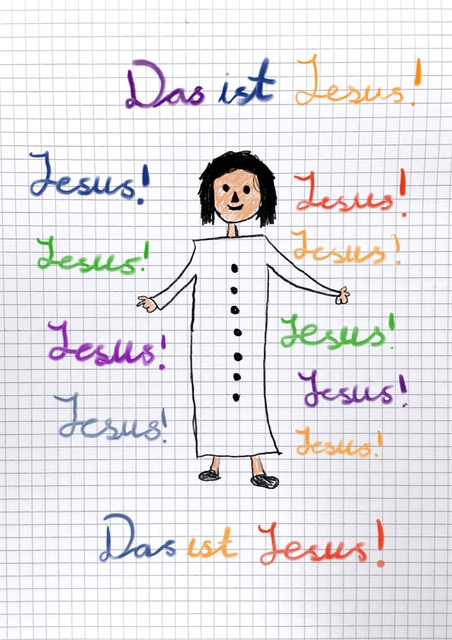
Changes in a child’s life are cause for joy. Watch for them, acknowledge them, and praise the child. Thank the Lord Jesus for them even if not everything has yet fully ripened into beautiful fruit.
When Marco took his first step on the narrow path, he said, "I know what pleases the Lord Jesus most of all." Intrigued, I asked him, "And what is that?" His answer was, "When you don’t commit the same sin a second time."
I had never heard a child say that with such earnestness and conviction before. Silently, I prayed that God would grant him the grace to do just that.
The spiritual insights of children will bring you great joy. In this regard, they often put many adults to shame. I have often marveled at the profound insights of children, insights that God revealed to them while they were reading His Word.
Offer them praise and recognition for this. Respond to it. Do not be sparing with your encouragement.
12 For Encouragement
Anyone who provides spiritual guidance to children also needs, time and again, a generous dose of encouragement. God granted me this at a time when deep worries and disappointment were intermingled with the joy and privilege of ministry; disappointment that believing children were no longer continuing on the path with Jesus, and concern for the others, wondering whether they would remain faithful.
In this situation, I read John 15:16 with fresh eyes.
Jesus says, "You did not choose Me but I chose you, and appointed you that you would go and bear fruit, and that your fruit would remain, so that whatever you ask of the Father in My name He may give to you."
Did you also discover the double promise in this verse?
1. You bear fruit.
2. Your fruit lasts.
Even as we strive to serve God faithfully and do all that we can for children, everything ultimately rests in God’s hands. He brings forth fruit. He ensures that it endures. The LORD does this even when our eyes must witness good, fresh fruit seemingly transform into dried fruit.
It is remarkable that the Lord Jesus’ twofold promise culminates in an assurance regarding prayer. "… so that whatever you ask of the Father in My name He may give to you."
It is a blessing for both you and me when we cherish this word and put it into practice.
I know that recommended Bible passages are not always heeded. But you really should read these verses in your Bible.
Please turn first to Psalm 116:6.
Do the same with John 10:27–30, and then turn to Philippians 1:6!
Read these verses several times. Reflect on them and trust them! For God truly means what He says when He gives us His promises.
Finally, let me return to the children’s meeting mentioned at the beginning of these pages.
Do you remember the protest raised by the boys and girls when they heard that it was supposedly impossible for children to be saved? "But it is true!" they shouted out loud in response.
Thank God! Children can believe and be saved, provided they have been well-taught in the Word of God and given the opportunity to come to Jesus.
Countless children stand as proof of this; they have experienced it personally. And many who came to faith as children are today professing Christians—at the university, in their vocational training, in their professions, within their families, and on the mission field.
God is building His Kingdom through the work of many volunteers and full-time workers who entrusted their lives to Him in their youth.
Winning children for Jesus Christ!
This is a privilege for us. It is an honor for the Lord.
Have these pages encouraged you to pursue this goal even more earnestly in your ministry to children? You will not regret devoting your best strength, time, and resources to winning children for Jesus Christ.
Remember: If a person is saved while still a child, then an entire life is saved. God does not wish to do without a single one.
For "it is not the will of your Father who is in heaven for one of these little ones to perish" (Matthew 18:14).
Our motive for winning children for Christ is not their lostness, but above all the glory of God. He alone has a claim to their lives, for He is their Creator and Redeemer. They belong to the LORD alone. Therefore, we strive to ensure that God receives His due and that children are won for Jesus Christ.
May the Lord bless you and protect you in your ministry among children!
Winning children for Jesus Christ
How you can lead a child to Jesus Christ
© CEF Germany
Copyright: © 2026 by KEB-Deutschland e. V.
Original title: Kinder für Jesus Christus gewinnen – Wie du ein Kind zu Jesus Christus führen kannst
Unless otherwise indicated, all Scripture quotations are from the New American Standard Bible (NASB).